
President Donald Trump has undertaken extensive renovations and new construction projects across Washington, DC, during his second term, altering the appearance of the nation’s capital from the White House grounds to federal office buildings. The changes include a new ballroom, a 250-foot triumphal arch, a memorial garden, and a UFC fighting cage erected on the White House South Lawn for a primetime event on Sunday, coinciding with the president’s 80th birthday and America’s 250th anniversary.
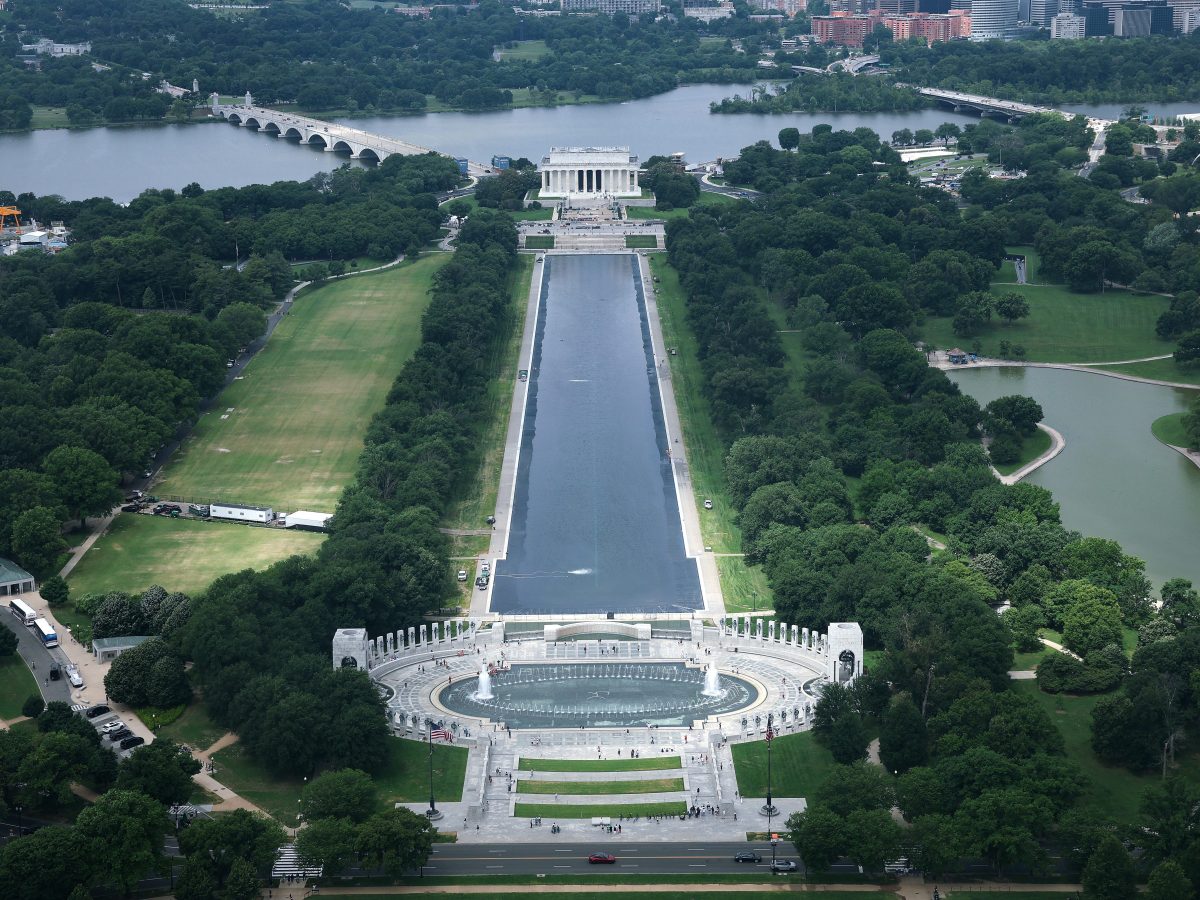
The administration completed the renovation of the Lincoln Memorial Reflecting Pool this week. The $14.8 million project involved sealing and painting the bottom of the pool a shade described as “American flag blue.” Officials cited government efficiency, beautification of the city, and marking the nation’s 250th birthday as reasons for the projects.
Many of Trump’s initiatives remain ongoing or are tied up in legal challenges. However, the changes already made to the White House and surrounding areas have visibly altered the capital’s landscape.
USAID Closure Marks Early Change
One of the first physical signs of the administration’s remodeling was the shuttering of the U.S. Agency for International Development (USAID). Shortly after taking office, Trump’s Department of Government Efficiency led a sweeping dismantling of the agency. The department froze USAID’s foreign aid, cut its staff and programs, and moved remaining functions to the State Department. Former presidents Barack Obama and George W. Bush condemned the move, with Obama calling it a “travesty.”
Administration officials framed the closure as a cost-cutting and accountability effort. Secretary of State Marco Rubio stated that USAID had “strayed from its original mission” and that “the gains were too few and the costs were too high.” The agency, founded in 1961 to counter Soviet influence during the Cold War, was housed in the Ronald Reagan Building and International Trade Center. Following its formal integration into the State Department on July 1, 2025, its staff, offices, and signage were removed from the building.
Presidential Portraits on Federal Buildings
In May 2025, the U.S. Department of Agriculture debuted 31-foot-tall banners showing Trump alongside Abraham Lincoln on the Jamie L. Whitten Building along the National Mall. The banners, installed to mark the USDA’s 163rd birthday, cost an estimated $16,400, according to the Washingtonian. The USDA’s then-director of communications, Seth W. Christensen, told The Washington Post that the banners “acknowledge the vision and leadership of USDA’s founder, Abraham Lincoln, and the best advocate of America’s farmers and ranchers, President Trump.”
The banners raised concerns about the politicization of federal buildings, as the norm is for presidential portraits to be displayed inside government buildings and updated between administrations.
In August, the U.S. Department of Labor installed its own Trump banners, initially for Labor Day but kept up during the nation’s 250th anniversary celebrations after a “tremendous positive response,” a department spokesperson told The New York Times. Those banners read “American Workers First” and depict Trump alongside Theodore Roosevelt, who helped lay the groundwork for the modern Labor Department.
A September report by Senator Adam Schiff of California noted that the U.S. Department of Health and Human Services had solicited 88-foot-tall banners promoting Health Secretary Robert F. Kennedy Jr.’s “Make America Healthy Again” slogan for an estimated cost of $33,726.
The latest federal department to display the president’s portrait is the Department of Justice, which traditionally operates with some independence from the White House. The banner, hung in February, features Trump’s portrait and reads “Make America Safe Again.”
The administration has also proposed a $400 million ballroom at the White House, which has sparked legal battles and public backlash. A 250-foot triumphal arch celebrating America’s anniversary, planned for the National Mall, would be the world’s largest if completed, though its fate remains uncertain amid legal challenges.
As of early 2026, several projects are still in legal limbo or awaiting further approvals. The administration has not released a timeline for completion of the arch or the ballroom, and no further announcements have been made about additional banners on federal buildings.