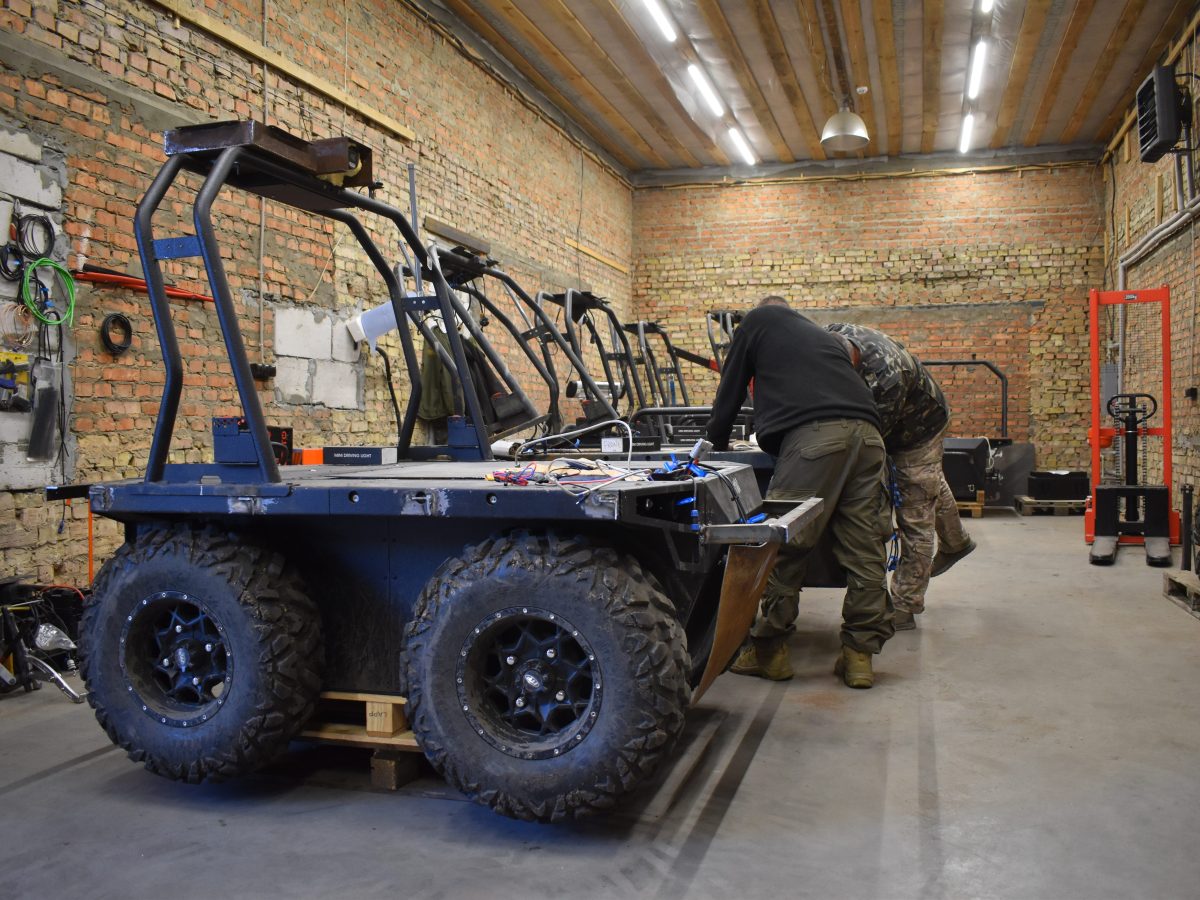

KYIV REGION, Ukraine. Ukraine is rapidly expanding production of unmanned ground vehicles (UGVs) to replace soldiers on a battlefield where the risk of death from mines, artillery, and drones has become severe. Factories outside the capital are assembling thousands of these machines for logistics, attack, and evacuation missions, as the country seeks to preserve human lives while sustaining combat operations.
Near the front lines in eastern Ukraine, a routine supply run has become a life-threatening task. Mines, artillery fire, and drone surveillance have created a zone where any movement can be lethal. Andrii Kushnierov, a platoon leader with Ukraine’s 59th Assault Brigade, told Business Insider that sending a human driver to deliver food or ammunition to troops in the trenches carries a high probability of death.
Ukrainian forces are now increasingly deploying ground robots to perform these dangerous tasks. The machines are no longer the crude, remote-controlled carts loaded with bombs that appeared early in the war. Business Insider visited a factory in the Kyiv region where workers are rapidly assembling a new generation of battlefield robots that resemble military-grade golf carts without seats or steering wheels.
Designed to Keep Humans Out of Danger
These UGVs are not built for a soldier to board and drive into battle. They are designed to keep the operator far from the front lines. After workers fit them with electronics, heavy-duty tires, and sensors, remote Ukrainian operators will send them toward the front to haul ammunition, evacuate wounded troops, lay mines, launch drones, attack Russian positions, and continue moving under fire.
Many of these vehicles will not survive long. Some may be destroyed within days of arrival. For Ukraine, this is an acceptable trade-off. The machines can be easily replaced. A soldier cannot. Factories across the country are racing to replace battlefield losses and expand production, offering a glimpse of what it takes to sustain a war increasingly dominated by drones. It is a manufacturing race for cheap, rugged machines that can be built quickly, adapted easily, repaired when possible, and replaced when destroyed.
From Street Lamps to Battlefield Workhorses
Taras Ostapchuk, CEO of Ratel Robotics, previously manufactured street lamps before the war. His company is one of hundreds in Ukraine now producing ground robots. Ratel built its first ground robot in late 2023, a small machine packed with anti-tank mines designed to drive toward Russian targets and detonate. Today, Ratel employs roughly 350 workers and can produce hundreds of UGVs per month.
Ostapchuk said the company’s robots cost between $2,000 and $40,000 depending on size and function, significantly lower than comparable European systems. “We know how to produce the cheapest battle-proof robots,” he said. Ukraine has built much of its wartime defense industry under pressure with limited resources and heavy dependence on foreign support. The same pressures are shaping its robotics industry as companies race to build low-cost, adaptable machines for a war that consumes equipment almost as quickly as it can be produced.
The vehicles rolling off Ratel’s factory floors are built for jobs Ukrainian soldiers increasingly avoid: hauling hundreds of kilograms of cargo or ammunition across the battlefield, laying mines, evacuating the wounded, launching FPV drones, and attacking Russian outposts. The company is also developing robots that can launch interceptor drones for air defense and execute amphibious casualty evacuation, logistics, and assault missions. Testing for the latter was scheduled to begin last month, with scaled production expected to follow quickly to support operations in southern Ukraine.
Ostapchuk said the goal is to destroy Russian enemies on the left bank of the Dnipro River, referring to intense fighting near the Ukrainian city of Kherson.
National Effort Accelerates Production
Ratel’s operation is part of a broader national effort. Ukrainian UGVs are being sent into battle with increasingly ambitious missions. President Volodymyr Zelenskyy said recently that robots had captured Russian positions and forced soldiers to surrender without direct infantry involvement. Ukraine contracted 25,000 ground robots in the first half of 2026, twice as many as in all of 2025, and Zelenskyy wants 50,000 produced by the end of the year. In April, Zelenskyy stated that Ukrainian-made robots had logged more than 22,000 missions since the start of the year.
Production continues to scale as the country seeks to replace soldiers in the most dangerous tasks on the front lines.